Devin launched at $500 a month. A year later, the entry tier costs $20.
Anthropic ripped the bundled tokens out of its enterprise seat plan and moved customers to $20 plus per-token billing on top. Salesforce keeps inventing new pricing structures for Agentforce because none of them works. Sierra hit $100 million in ARR in 21 months by charging per resolved customer issue. Intercom’s Fin agent went from $1 million to over $100 million in ARR by charging 99 cents per resolved ticket.
The companies pricing AI agents are in an open war with their own economics. And most builders haven’t figured out which side they’re on.
Why pricing AI agents is harder than pricing SaaS
Software pricing was easy for two decades because the second customer cost you almost nothing. Sell a seat. Add another. Grow.
That assumption is dead for AI agents.
A heavy Notion user costs you nothing extra. A heavy user of an AI agent can torch your gross margin in a single weekend of Claude calls. ICONIQ’s 2026 State of AI report puts average AI gross margins at 52 percent, well below the 70 to 80 percent that traditional SaaS targets. Inference now eats a chunk of your margin every quarter.
The math underneath your pricing page changes every quarter. Token prices for GPT-4-class performance fell from about $20 per million tokens in late 2022 to $0.40 today. That’s a 50x collapse in three years. Whatever you priced in 2024 is overpriced today and will be obsolete next year.
You’re pricing a meter you don’t fully control.
The three pricing models that actually exist
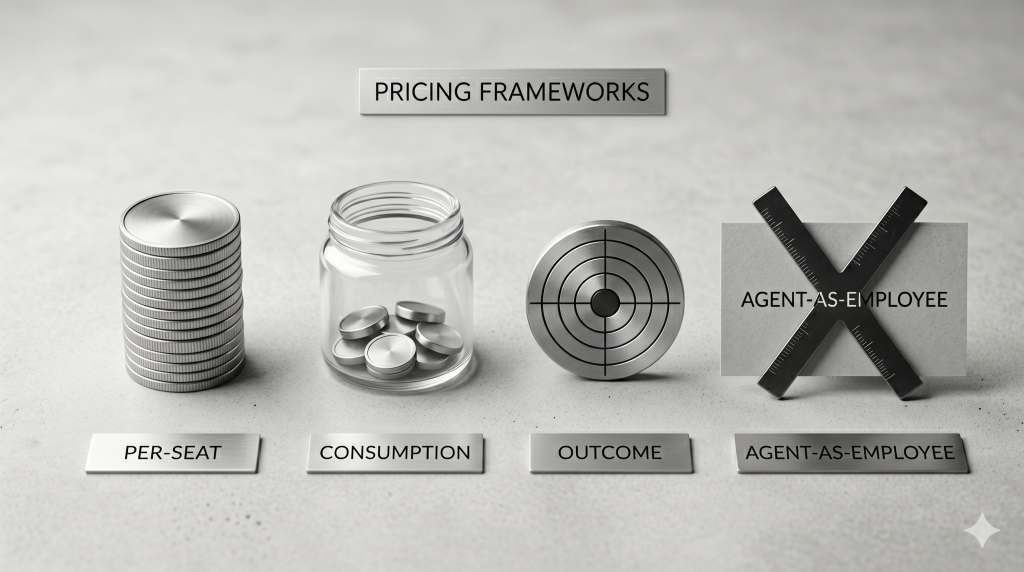
There are three legitimate pricing models for an AI agent. Per-seat. Consumption. Outcome. Everything else is a flavour of one of these, or a hybrid.
Vendors keep pitching a fourth model: “agent as employee.” It’s marketing language dressed as pricing. We’ll come back to it.
Per-seat works for agents humans drive, then breaks
Per-seat is the model your SaaS playbook taught you. One human, one licence, one monthly fee. Predictable for the seller. Budgetable for the buyer. Procurement teams can sign it without a fight.
It still works for agents that humans drive: the copilot category. GitHub Copilot charges $10 per month for Pro and $39 for Pro+. Cursor sits at $20 individual and $40 for Business. The seat correlates with consumption because a person can only review so many suggestions in a day.
Then your agent goes autonomous, and per-seat stops working.
One power user can hit your tokens 100 times harder than the median, and your gross margin on that customer evaporates. Per-seat’s share of SaaS pricing dropped from 21 percent to 15 percent in twelve months across companies adding AI capabilities, and for autonomous (non-copilot) agents it’s already below 30 percent of the market. Companies still anchored to per-seat for AI report 40 percent lower gross margins and 2.3 times the churn of usage- or outcome-based peers.
There’s a deeper trap. The cannibalisation trap.
If your agent makes a 50-person team do the work of 80, your customer doesn’t add 30 new seats. They hold headcount flat. Your expansion revenue dies in a meeting you weren’t in. You shipped a product so good your customer’s best response is to renew flat, or to cut seats and pocket the difference.
Consumption is the honest model CFOs can’t sign
The honest model is consumption. You charge for what gets used. Tokens. Calls. Minutes. Credits.
This is what Anthropic and OpenAI’s APIs run on, and it’s how most developer-facing agent products bill. The pricing aligns with cost, which means your margin survives even when one customer becomes a whale.
Enterprises hate it.
A CFO who can’t tell you what the AI bill will be in Q3 cannot approve the contract. Procurement cannot sign a meter. The bill-shock pattern is consistent: a customer pilots in month one with 10,000 calls, hits 100,000 by month six, and gets a bill ten times what their finance team modelled. 78 percent of IT leaders report unexpected charges from consumption-based AI pricing. Cost forecasting tops CIO surveys for AI deployment.
Even Anthropic, a company that ships better documentation than most, is struggling to communicate its enterprise pricing. In early 2026, Anthropic moved Claude Enterprise off bundled-token seat fees and onto a $20 seat plus standard per-token rates on top. Customers who do the math are paying more for less predictability.
Devin’s pivot was sharper. The AI software engineer launched at $500 a month for the Team plan. A year later, the entry tier was $20 plus pay-as-you-go ACUs at around $2 each, where one ACU is about 15 minutes of autonomous work. Customers report budgeting for $20 and getting invoiced for $400. The headline price is now a doorway. The bill comes from somewhere else.
Outcome works when you can define the outcome (and most can’t)
Outcome-based pricing is the model VCs talk about at dinner. You charge per resolution, per booked meeting, per closed ticket, per qualified lead. The pitch writes itself: you only pay when it works.
The successful examples are real and they are large. Sierra, Bret Taylor’s company, hit $100 million in ARR 21 months after founding by charging per resolved customer issue. Intercom’s Fin went from $1 million to over $100 million ARR on a single pricing decision: 99 cents per resolution, billed only when the customer confirms the answer worked or exits the conversation without escalating.
The model has two failure modes that most pitches paper over.
The first is attribution. Resolution is opaque, and each vendor has its own definition. Some count a “resolution” the moment a customer clicks an article link. Others wait for explicit confirmation. Others count it as resolved when the customer gives up and walks away. Operations leads at AI customers have started auditing every line of the bill, arguing about what counted. Decagon offers per-resolution pricing alongside per-conversation, and third-party analyses note that most customers default to per-conversation because resolution is too disputable to trust at scale.
The second is the improvement penalty. Your bot gets better. It resolves more tickets. Your customer pays more for the same volume of inbound demand. You’ll have an awkward renewal call when “we got better at our job” lands in the buyer’s inbox as “we increased your bill by 30 percent.”
Outcome works when three things are true. The outcome is measurable. The agent’s contribution is attributable without a forensic audit. The unit makes sense even when the bot improves.
Customer support resolutions qualify. Sales meetings booked qualify. Strategic insight, marketing creativity, complex sales? Probably not.
The trap: pricing your agent as an employee
There’s a fourth pricing frame most vendors keep off their pricing pages but lean on in sales pitches. It’s the most popular framing of 2026. And it’s the most dangerous thing you can sign your name to.
The pitch goes like this. “Our agent costs $40,000 a year. The SDR you’d hire costs $90,000. We save you $50,000.”
Customers love hearing it. CFOs love hearing it. The framing turns a software contract into a no-brainer headcount conversation, and it gets you in the door faster than any feature comparison.
Use it in the deck. Don’t put it in the contract.
I came across this story recently. An AI agent vendor opened their pitch with “we replace 5 FTEs for the cost of 1.” The client ran the math, looked up, and asked the obvious follow-up: “Why can’t we pay 1/5 the price, then?” The vendor wasn’t ready. They pivoted. The deal didn’t close.
When you price your agent as an employee, four things break.
The first: salary anchors your ceiling. Once a buyer thinks of you as “1 FTE replacement,” they won’t pay 2x an FTE, even if your agent does the work of five. The salary becomes a wall you can’t climb above. You’ve capped your expansion before you’ve signed the first contract.
The second: headcount thinking caps your scaling. Salaries grow linearly. Agents scale 100x or 0.1x depending on workload. Pricing as a person locks you to the linear curve, and the linear curve is the worst curve in technology.
The third: it invites apples-to-apples comparison. Buyers will ask whether your agent has the judgment of a senior. They’ll downgrade you against a junior FTE you cannot actually replace one-for-one. Once that comparison runs, you spend the rest of the cycle defending why you’re not a person.
The fourth, and the worst: HR-style scrutiny is brutally applied to software. “Performance review” becomes “Are we getting our money’s worth?” Real employees get ramp time, coaching, and the human-grace allowance when they screw up. Your agent gets none of that.
Klarna is the cautionary tale most AI vendors are still pretending isn’t real. In early 2024, the company announced its AI assistant had replaced the equivalent of 700 customer service agents and was on track to deliver $40 million in profit improvement. The press releases were spectacular. By 2025, Klarna was rehiring humans because the AI couldn’t meet the company’s standards for customer experience. The “FTE replacement” frame was the marketing. The product reality was a hybrid: AI for routine queries, humans for the cases that actually mattered.
The “we replace humans 1-for-1” story was marketing from the start. The vendor who priced their contract on it lost the renewal.
Bret Taylor put it cleanly on the Sequoia podcast: “If you’re selling software that completes a job, what is the secular business model for that?” Stop selling productivity enhancement. Start selling outcomes. Price the resolution. Price the call handled. Don’t price the FTE.
Here’s what to actually do.
Use the FTE comparison in your pitch deck. Anchor ROI in cost-of-FTE-not-hired. Show the math. Win the meeting.
Then bill in seats, consumption, or outcomes. Sign a contract that doesn’t trap you in salary economics. The FTE frame opens the door. It shouldn’t close the deal.
How to actually decide
The right pricing model is rarely the one your competitors use. It’s the one that survives your unit economics at the 95th percentile of usage.
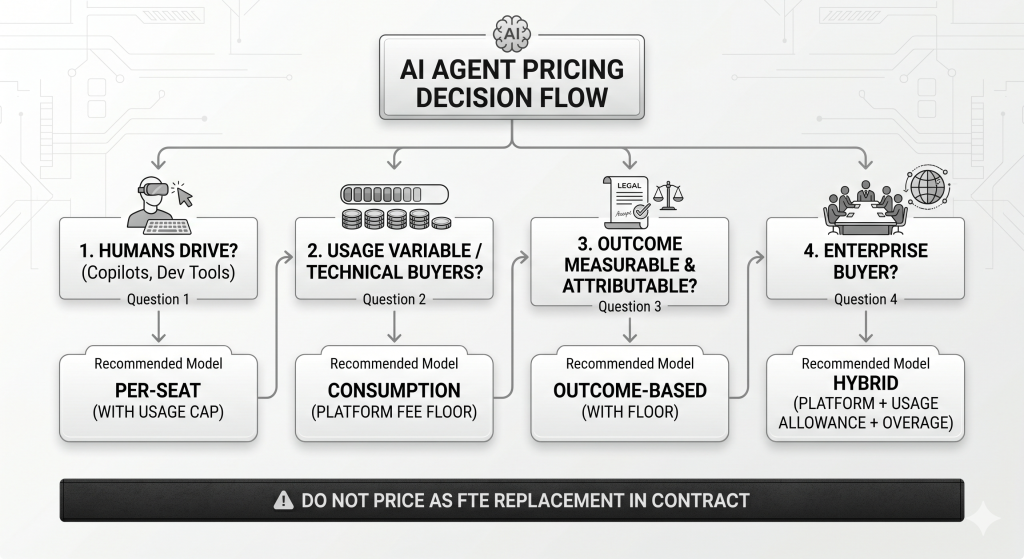
If humans drive your agent (copilots, dev tools, writing assistants, sales enablement), start with per-seat and add a usage cap. Cursor and Copilot are the working examples. The seat protects your predictability. The cap protects your margin from the one user who decides to vibe-code the entire codebase in a weekend.
If your usage swings hard across customers and your buyers are technical, consumption is the honest answer, but only with a platform fee underneath it. Pure consumption is a meter that scares enterprise CFOs. A platform floor turns it into a hybrid that procurement can sign.
If your outcome is measurable, attributable to your agent, and rarely disputed, go outcome-based. Customer support resolutions, sales meetings booked, tickets closed are the proven categories. Add a floor so a slow month doesn’t zero out your revenue.
If you’re selling to enterprise, you’re going to end up at hybrid no matter where you start. The dominant 2026 enterprise structure is platform fee plus usage allowance plus overage rate. Most serious AI vendors land here within 18 months of their first contract, and most SaaS incumbents adding AI are already there.
If your model is “we charge per FTE replaced,” you have a slogan.
What you should actually do Tomorrow
Most builders pick a pricing model the way they pick a starter logo. From a default. From whoever’s on the front page of their VC’s Notion doc. From the model that their last company used.
The default is wrong. Pick the model that survives next year’s token price cut. The one that maximises this quarter’s gross margin will leave you priced out by next year. Pick the model your customer’s CFO can sign without arguing. Pick the smallest pricing structure that protects your margin at the 95th percentile of usage.
And whatever you do, don’t tell your customer they’re paying you per FTE. Use it to win the meeting. Don’t use it to write the contract.