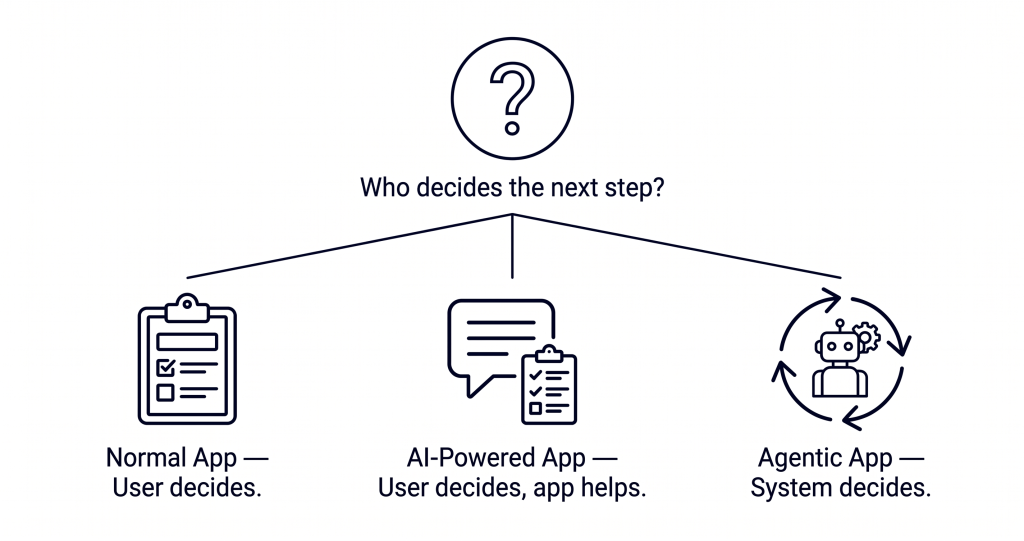
I ask the same question every time someone tells me they’re building an AI agent: “What agentic capabilities does it have? Who takes the next step — the model or the user?”
Most of the time, there’s a pause. Then a rephrase. Then I realise we’ve been talking about three different things and calling two of them agents.
A normal app. An AI-powered app. An agentic app. Most teams are building the second one and paying for the third.
The binary is the problem
The dominant framing in 2026 is binary.
You hear people ask “is it AI, or is it agentic?” That question skips the category most software still falls into: apps with no AI at all. A CRM record form. A procurement tool. Your internal dashboards. Most of what your team ships this quarter won’t use a language model. The taxonomy has three buckets, not two.
The binary framing is also expensive. Gartner counted the real agentic vendors this year and found about 130 out of thousands. They also predict 40% of agentic AI projects will be cancelled by end of 2027, largely because teams scoped agents for problems that didn’t need them. Harvard’s Corporate Governance Forum treated “agent washing” as a securities disclosure risk this month, which is a legal category, not a marketing one. The definitional slop is now real money.
The one question, and the three answers
The question is this: in the workflow you’re scoping, who decides the next step? The user, the app, or the system?
Agree on that one variable, and the taxonomy falls out. A practitioner test circulating in 2026 rhymes with it: does the thing iterate? Does it take actions beyond generating text? Does it decide its own next steps? If any answer is no, what you have is an LLM. Maybe a very good one. Not an agent.
Three answers. Take them in order.
When the user decides: a normal app
The user clicks a button. The app does the thing the button says it will do. No model involved. Input goes in, output comes out, and a competent engineer can predict the output from the input every time.
This is still most software. Your CRM. Your CI/CD tool. The form that books your meeting rooms. The Jira board you updated this morning. A normal app is the right scope for most workflows that have rules you can write down and a stable process. Boring works.
Anthropic’s own guide to building agents opens with the same advice: find the simplest solution that works, and only increase complexity when you need to. Sometimes the simplest solution is not to use AI at all. The company selling the most capable agent model in production is the one telling you not to build one unless you have to.
For the non-technical version, think of a vending machine. Pick a button, get the thing. No surprises.
When the user decides and the app helps: an AI-powered app
A friend was showing me an “agent” last week. You open a chat window, type “2 hours on the product migration today,” and it fills your timesheet. No opening the timesheet app, finding the project, finding the row, typing the hours. Just chat. He was genuinely excited.
Run the question on it. Who decided the next step? He did.
He decided he had worked on product migration. He decided to log it. He wrote the sentence. The AI parsed his sentence and filled a form over an API. One model call, one action, done.
It was an AI-powered front-end on a timesheet app. A chat interface in front of a form. That’s fine. It’s probably a better timesheet app than the one without chat. Calling it an agent, though, is how companies scope $200,000 builds for $15,000 problems, and how Gartner ends up with a 40% cancellation number.
Most teams saying “agentic” are actually in this category. One clever model call wedged into an otherwise deterministic workflow. Gmail’s Smart Reply. Grammarly. Notion AI’s summarise button. GitHub Copilot’s autocomplete. Canva’s Magic Write. All useful. None of them agents.
The economic problem is sharper than the vocabulary one. Teams ship AI-powered features, label them agentic, charge accordingly, then watch nobody use them. One VP of Product told Gigacatalyst their flagship AI assistant hit 4% weekly active usage six months after launch, after three-quarters of their engineering time. Three other product teams quoted in the same piece reported similar numbers: 6%, 3%, and 2%. If you called your 4%-adoption feature agentic, you are paying agent prices for chatbot capability.
Non-technical version: a vending machine with a recommendation screen. It tells you what’s popular. You still press the button.
When the system decides: an agent
You hand the system a goal. It plans. It picks a tool. It calls the tool. It reads the result. It picks the next tool. It loops until the goal is met or it hits a boundary you set. Somewhere in there it might ask you a question, but you did not click a button to get from step 3 to step 4.
Anthropic’s definition is the one that won the 2025 debate: systems where LLMs dynamically direct their own processes and tool usage, maintaining control over how they accomplish tasks. That is the bar. Four things have to be true at once. The system acts without asking permission at every step. It uses tools. It carries memory and state across turns. And it loops: it observes the result of its own action and decides what to try next.
Miss any one of those four, and you have an AI-powered app with extra steps.
Not an agent.
Real examples, not marketing pages. Claude Code in autonomous mode, reading a codebase and editing files and running tests until they pass. Cognition’s Devin, chewing through engineering tickets. Cursor’s Agent mode (not the autocomplete in the same app). An OpenAI search agent is browsing multiple sources and synthesising a report. Salesforce’s Agentforce in its Headless 360 configuration, where 60+ new MCP tools and 30+ coding skills give agents live access to the whole platform.
Non-technical version: a personal assistant. You hand them a goal, like “stock the break room,” and they pick the vendor, the delivery, the snacks. You check the outcome, not the steps.
The same expense report, three scopes
Expense reports are a good test case. Everyone hates them. Every company has to do them. The workflow is stable enough to automate and variable enough to be interesting.
Here is the same job, scoped three ways.
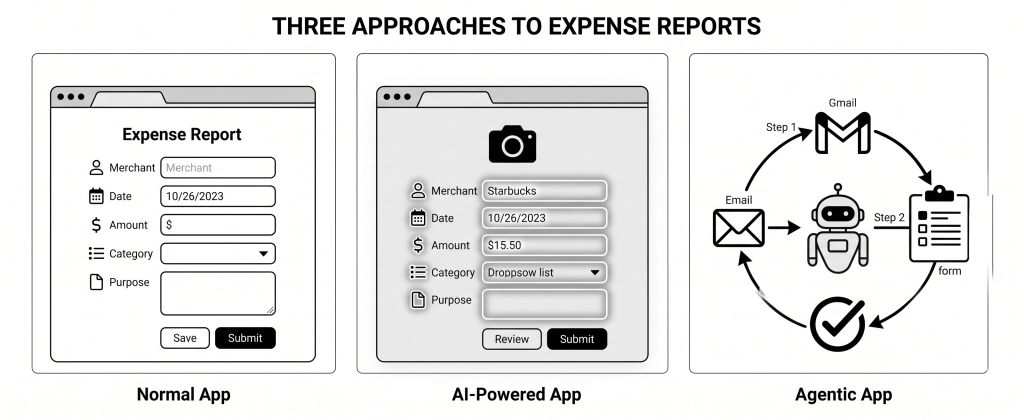
The normal-app version is a form. Fields for date, category, amount, receipt upload. You fill it, you submit it, a rule routes it to your manager. This is what Concur and Expensify actually shipped for most of their history. Every 40-person startup could build it in a sprint. It works.
The AI-powered version is the same form, but you snap a photo of a receipt and an OCR-and-model combo pre-fills the fields. You correct the one it got wrong. One model call per submission. The user still drives: you picked which receipt to scan, you confirmed the category, you clicked submit. Most modern expense tools are here now.
The agent version starts when you forward the hotel confirmation email to a dedicated inbox. An agent pulls the flight receipt from your Gmail, classifies the meal charges against company policy, fills the form, attaches the receipts, and submits it. It pings you only if something needs a human decision, like a $600 dinner flagged against the per-meal cap. Multiple model calls. Multiple tool calls. Memory of your travel patterns. A loop on failure.
All three are legitimate scopes. The decision is a tradeoff between autonomy and the cost of building and governing it, not a question of which category is more advanced. Agent builds start at $8,000 and can run over $400,000, with monthly operating costs up to $20,500 before governance overhead. For an expense form at a 40-person company, the normal-app version is almost always the right answer.
Where the question gets messy
Two cases break the clean answer.
Some products run in multiple modes. Cursor has both: autocomplete is AI-powered, Agent mode is an agent. Classify the mode, not the product. The same applies to Copilot, Notion AI, and most of the Claude Code surface. When someone says “our product is agentic,” ask which mode they mean.
Some “agents” are technically agents but operate at such low autonomy that the label is misleading. The Cloud Security Alliance’s January 2026 framework puts advisory-only systems at Level 0, the same category as a recommendation engine. A system that only suggests and a human approves every action is technically an agent by some definitions. In practice the mental model is still copilot.
The future blurs the line further. In two or three years, most AI-powered apps will ship with some agentic capability as a baseline, the way most apps shipped with a mobile version a decade ago. The question will shift from “is it agentic?” to “what level of autonomy?” — something closer to SAE’s 0-5 scale for self-driving cars than a yes-or-no.
What to do Tomorrow
Open your product roadmap. For every initiative with “AI” or “agent” in the title, answer the one question: who decides the next step?
Count how many say the user. Those are AI-powered apps. If you scoped them as agents, reset the scope before the budget review. You will save your team three months and your company a six-figure build.
Count how many say the system. Those are real agents. Check whether you actually have the governance for them: logging, kill switches, permission boundaries, a human-in-the-loop escape hatch. If you don’t, that’s a separate and urgent problem. A different post.
Most teams don’t need agents. Figuring out which ones do is the real product work.