The Misery of the Middle
Product Management is a paradoxical profession.
On Monday, you are expected to be Richard Rumlet, a visionary setting a 5-year horizon that will disrupt the market. On Tuesday, you are expected to be Bob the Builder, working through Jira tickets, unblocking engineers, and arguing about the pixel padding on a “Submit” button.
We are told that the job is to be the CEO of the product (I don’t believe in the notion of Product Manager being the CEO of the product). But in reality, we often feel more like the janitor of the backlog.
The stress of this role doesn’t come from the workload. It comes from the cognitive overload. It is the harsh disconnect between the Half-yearly Strategy Offsite full of sticky notes, and fresh coffee. Versus the weekly morning stand-up where engineers are blocked, the roadmap is bleeding red, and Sales just sold a feature that doesn’t exist.
Most product managers don’t fail because they lack skills. They struggle because the gap between big-picture vision and daily work is just too wide.
So, human nature takes over. To cope with the anxiety of the “Messy Middle,” we retreat to the extremes. We pick a side. We either hide in the clouds of strategy or we bury our heads in the sand of execution.
Both choices feel safe. Both choices will kill your product.
The Diagnosis: Which Trap Are You In?
You need to look in the mirror. When the tension rises and ambiguity sets in, where do you go? Most teams fall into one of two deadly traps.
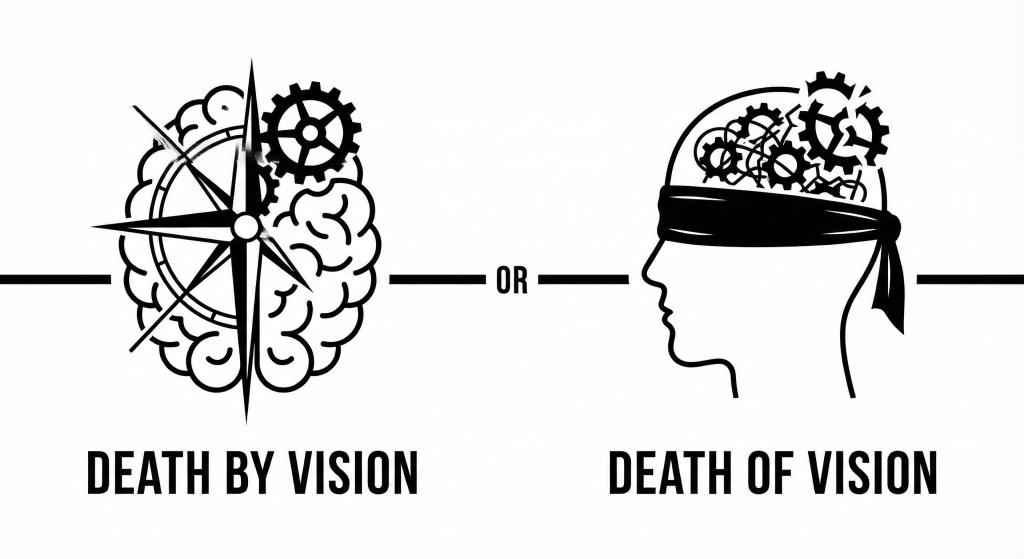
Trap 1: Death BY Vision (The “Think Tank”)
This is the trap of Intellectual Safety.
In this mode, the team convinces themselves that if they just plan hard enough, analyze enough data, and debate enough hypothetical scenarios, they can eliminate the risk of failure before writing a single line of code.
It shows up as “Strategy Theater.” You feel smart. You feel strategic. But you aren’t actually creating value.
You know you are in the Think Tank when you look at your “Strategy Deck.” It’s currently on Version 14.2. It features beautiful Figma mockups of a comprehensive ecosystem you plan to launch in 2026. The slides are immaculate. The logic is sound.
But if you walk out of that conference room and look at your engineering team, they are fidgeting with their thumbs. Or worse, they are refactoring old code or “paying down tech debt” simply because Product hasn’t given them a clear spec for the current sprint.
You are terrified of shipping the wrong thing, so you ship nothing. You justify the delay by saying, “We need one more pivotal data point before we commit.”
The Truth: A vision that doesn’t result in software being shipped isn’t a strategy; it’s a hallucination.
Trap 2: Death OF Vision (The “Hamster Wheel”)
This is the trap of the Dopamine of Output.
This is the classic “Feature Factory.” In this mode, success is measured by velocity, burndown charts, and the high number of tickets moved to the “Done” column. It feels good to check boxes. It looks like productivity. Executives love it because everyone looks busy.
But this is motion without progress.
You know you are in the Hamster Wheel when your team hits their velocity targets for four sprints in a row. Everyone high-fives at the retrospective. You are crushing the roadmap. Yet, when you look at your product metrics, they are flatlining.
Why? Because you just shipped 12 features that nobody asked for, simply to “feed the beast” and keep developers typing. You are building a Frankenstein product, a collection of disjointed features stitched together with no soul and no direction.
The Truth: If you are shipping faster than you are learning, you are just accelerating your demise.
The Root Cause: The Comfort of Extremes
If these traps are so deadly, why do smart Product Managers keep walking right into them?
It’s not because they are lazy. And it’s not because they are incompetent. It is because of fear.
As humans, we are hardwired to hate ambiguity. And the job of a Product Manager is to live in the “Messy Middle” that terrifying space where strategy meets execution. This is where you have to make high-stakes bets with incomplete information. It is where you risk being wrong in public.
That ambiguity is painful. So, we retreat to the extremes because they feel safe.
The “Visionaries” retreat to the whiteboard. Why? Because ideas on a whiteboard can’t fail. A strategy deck cannot crash in production. A roadmap cannot get any review from the customer. It is a safe haven where everything is perfect and nothing is broken.
The “Executors” retreat to Jira. Why? Because moving a ticket to “Done” releases a hit of dopamine. It is tangible proof that you did something today. It drowns out the existential fear of “are we building the right thing?” with the comforting noise of “look how much we built.”
We see this play out in meeting rooms every single day.
The Mental Model: The Purpose vs. Pace Matrix
We can map every product team on a simple 2×2 matrix based on two variables:

- Y-Axis: Strategic Intent (The “Why”). How clearly defined is the problem? How rigorous are the constraints?
- X-Axis: Shipping Cadence (The “What”). How frequently is value reaching the customer?
Here is where your team lives:
1. The Zombie Zone (Low Intent / Low Cadence)
This is a dying product. The team is confused about the vision, and they aren’t shipping anything to figure it out. Morale is low, and turnover is high. If you are here, you don’t need a blog post; you need a pivot or a new job.
2. The Think Tank (High Intent / Low Cadence)
This is Death BY Vision. The team is incredibly smart. They understand the market, the user, and the long-term goal. But they are terrified of “wasting” engineering cycles, so they refuse to build until the specs are perfect. They have high potential energy, but zero kinetic energy.
3. The Hamster Wheel (Low Intent / High Cadence)
This is Death OF Vision. This team is a machine. They crush their Jira tickets. They release every two weeks like clockwork. But because there is no strategic filter, they are running in circles. They are “busy,” but they aren’t going anywhere.
4. The Value Engine (High Intent / High Cadence)
This is the Goal. This isn’t about having a “perfect” strategy and “perfect” speed; that’s a myth. This is about having enough strategy to give direction, and enough speed to validate it.
The Iterative Loop
The secret of the Value Engine quadrant is that they treat Strategy and Execution as a loop, not linear steps.
In the Think Tank, Strategy dictates everything (top-down). In the Hamster Wheel, Execution dictates everything (bottom-up).
In the Value Engine, the relationship is circular:
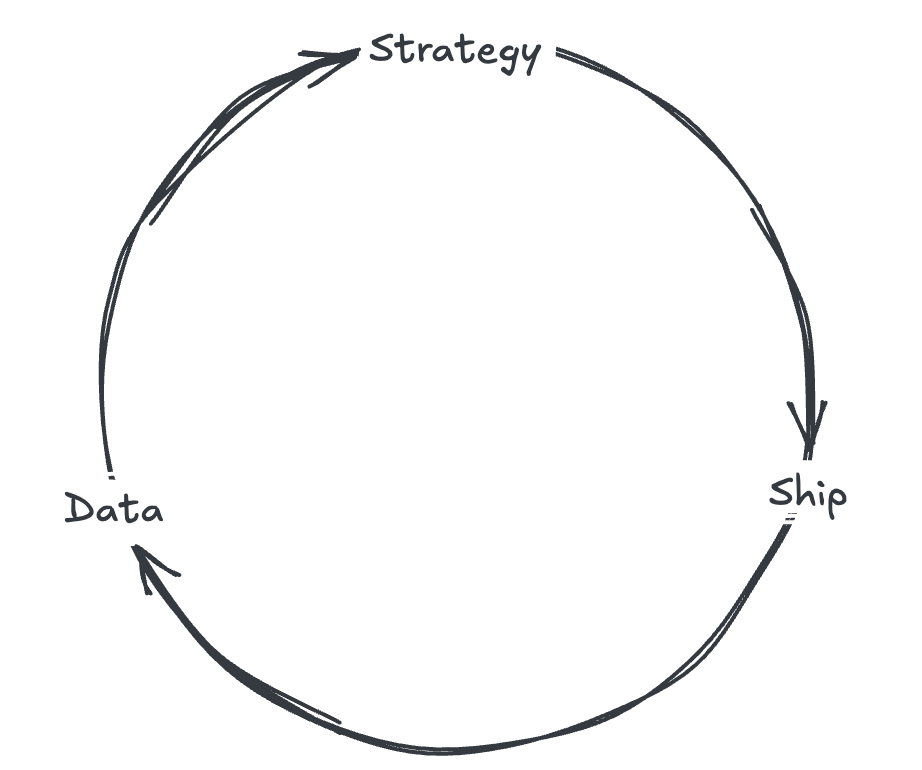
You use your Vision to make a hypothesis. You ship the smallest possible thing to test that hypothesis. You get real data (not opinions). You use that data to update the Vision.
Instead of debating a potential new product line for six months (Think Tank) or building the whole thing blindly because a VP asked for it (Hamster Wheel), the Value Engine team ships a “Fake Door” landing page in three days.
If nobody clicks the “Sign Up” button, they kill the project. They saved six months of work by shipping in three days. That is the power of the Value Engine.
The Core Insight: Vision is a Constraint, Not a Painting
To escape these traps, we have to fundamentally rewire how we think about “Product Vision.”
Most organizations treat Vision as a painting on the wall. It is a destination, a shiny, happy future state that we aspire to reach someday. It sits in a deck, looking pretty, while the team slogs through the mud of the backlog.
This is wrong.
A Vision that is just a “destination” is useless. It allows you to justify almost anything. “Well, in the future, we want to be a platform for everyone, so building this random feature technically fits the vision.”
True Vision is not a painting. True Vision is a filter.
It is a tool for subtraction. Its primary purpose isn’t to tell you what to build; it is to give you the confidence to delete items from your backlog.
If your vision is broad enough that it allows you to say “Yes” to every stakeholder request, you don’t have a vision. You have a wish list. You are hallucinating.
Real strategy requires sacrifice. It requires looking at a “good” idea and killing it because it doesn’t fit the specific constraints of your vision.
Let’s look at how this plays out in the real world:
Imagine a Sales Leader storms into your office. They have a massive prospect on the hook, but the deal hinges on a bespoke, custom feature.
The “Death of Vision” team says “Yes.” They build it to close the deal. They get the revenue, but they inherit technical debt and a feature that only one customer will use. They have lost focus.
The “Death by Vision” team says “Okay”. They will return to their strategy and create a Jira ticket to analyse the request further. They will neither say “Yes” nor “No” and spend time on analysing which they do not intend to build in the first place.
The “Value Engine” team doesn’t just say “No.” They slap a price tag on the “Yes.”
They look at the Sales Leader and say: “Our vision is to build a scalable Self-Serve platform. This custom feature breaks that constraint. We can build it, but it will delay the Platform launch by 6 weeks. Do you want to explain to the Board why we missed the Q3 launch, or should I?”
That conversation is brutal. It risks conflict. But it saves the product from becoming a Frankenstein monster.
The “Aha!” Moment: You don’t “balance” vision and execution. You use vision to ruthlessly filter execution.
How to Escape Your Trap
Diagnosing the problem is the easy part. Fixing it requires breaking the habits that got you there. The medicine depends entirely on which poison you’ve been drinking.
If You Are Stuck in “The Think Tank” (Death BY Vision)
- The Cure: Artificial Constraints.
- The Problem: You are suffering from perfectionism. You are waiting for certainty in a world where certainty doesn’t exist. You need to force the issue.
- The Tactic: The “Time-Boxed MVP.” Stop scoping based on features (“We launch when X, Y, and Z are ready”). Start scoping based on time (“We launch in two weeks. What fits?”).
- The Scenario: Ban the phrase “Phase 2.” If you catch yourself saying, “We’ll fix the UX in Phase 2,” you are hiding. Force the team to ship a vertical slice—however thin—that actually functions.
- The Mindset Shift: Value is not created when you design it. Value is created when a customer touches it. Until then, it is just inventory.
If You Are Stuck on “The Hamster Wheel” (Death OF Vision)
- The Cure: The Strategic Pause.
- The Problem: You are suffering from momentum without direction. You are afraid that if you stop shipping, people will realize you don’t know where you are going. You need to stop the line.
- The Tactic: The “Why” Interrogation. Refuse to let a ticket enter the sprint unless it has a clear hypothesis attached to it.
- The Scenario: Call a “Cleanup Sprint.” Tell stakeholders you are pausing feature work for two weeks to review the data from the last five launches. If you can’t find data on those launches, that is your answer: you are building blindly. Stop building until you install analytics.
- The Mindset Shift: Stop burning cash on features that don’t move the needle. Pausing feels dangerous, but shipping features that zero users adopt is just an expensive way to look busy.
The Takeaway: The Two-Way Link Test
Philosophy is great, but you have a stand-up meeting tomorrow morning. Here is a specific tool you can use immediately to stop the bleeding.
The “Two-Way Link” Test
Open your backlog or your Sprint Board. Pick three random Feature tickets (exclude bugs or server maintenance). For each ticket, ask the PM (or yourself) to trace the line in both directions immediately:
- Upstream (The Strategy): “Which specific strategic pillar, OKR, or ‘Big Rock’ does this ticket directly advance?”
- If the answer is “It helps the platform” or “It’s generally good for UX,” FAIL.
- It must be specific: “This reduces onboarding friction, which is our Q3 OKR.”
- Downstream (The Learning): “What specifically will we learn about our vision by shipping this?”
- If the answer is “Nothing, it’s just a requested feature,” FAIL.
- It must be specific: “We will learn if users actually want to export to PDF before we build the CSV exporter.”
The Rule: If you cannot draw a straight, unbroken line from the Ticket to the Vision (Upstream) and to a Learning (Downstream), delete the ticket.
Note: Do not apply this to “Keep the Lights On” (KTLO) work like critical bugs or compliance. However, if a bug isn’t blocking a strategic outcome or user value, question why it’s in the sprint at all.
Conclusion: Be the Gatekeeper
We want the job to be clean. We want it to be just Strategy or just Execution.
But that’s not the job.
The Product Manager’s job isn’t to be a passive bridge between stakeholders and engineers. Bridges get walked all over.
Your job is to be the gatekeeper. You are the only person standing between your expensive engineering team and a backlog full of garbage. You have to make the hard choices that nobody else wants to make.
It is uncomfortable. It is exhausting. You will feel the pull of the extremes every single day.
Don’t give in. Stand in the middle.